Ecosite Level Bioassessment and Digital Modelling of Ashtamudi Wetland: A Mesoecosystem Approach to Ecological Zonation
Alexander T
*

Department of Environmental Science, St. John’s college Anchal, University of Kerala, India.
*Author to whom correspondence should be addressed.
Abstract
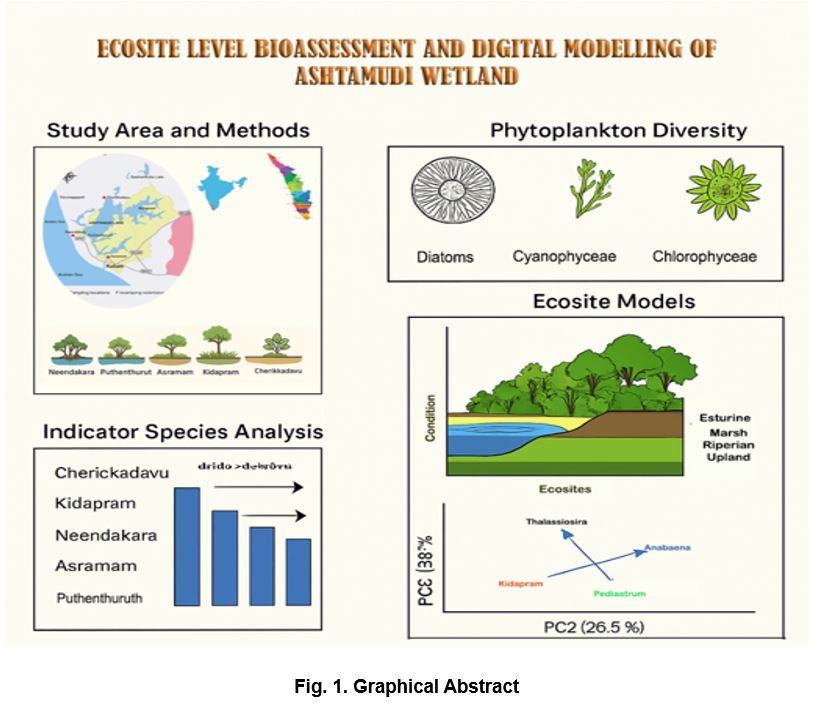
This study presents an integrated bioassessment and digital modelling framework applied to five ecosites within the Ashtamudi Wetland, a Ramsar-designated estuarine ecosystem in Kerala, India. Using a mesoecosystem-scale approach, ecological heterogeneity was assessed through physico-chemical water quality parameters (salinity, nutrients, dissolved gases), phytoplankton diversity indices, and vegetation structure. Water quality analysis revealed a distinct gradient from marine-influenced to freshwater-dominated conditions across ecosites, with elevated salinity and carbon dioxide at Neendakara and higher nitrate concentrations at Kidapram and Cherikkadavu. Phytoplankton assemblages were dominated by diatoms and cyanophyceae, with maximum species richness recorded at Cherikkadavu and Kidapram, indicating higher trophic productivity in freshwater-influenced zones. Principal Component Analysis (PCA) explained 78.6% of the total ecological variance, clearly separating ecosites along salinity and nutrient gradients. Indicator Species Analysis identified site-specific bioindicators, including Trichodesmium at the estuarine mouth and Nymphaea stellata in freshwater-dominated ecosites. A major outcome of the study is the development of conceptual ecosite models, generated using Adobe Photoshop CS2, which spatially represent shoreline, marsh, riparian, and upland vegetation zones based on field-verified species assemblages and habitat characteristics. These models provide a practical visualization tool for wetland zonation, restoration planning, and ecosystem-based management. Overall, the study demonstrates that ecosite-based classification integrated with bioassessment indicators offers a robust and scalable framework for adaptive management, land-use planning, and biodiversity conservation in complex tropical wetland systems. The abstract is graphically illustrated in Fig. 1.
Keywords: Ashtamudi wetland, ecosite modelling, indicator species, phytoplankton diversity, wetland zonation